
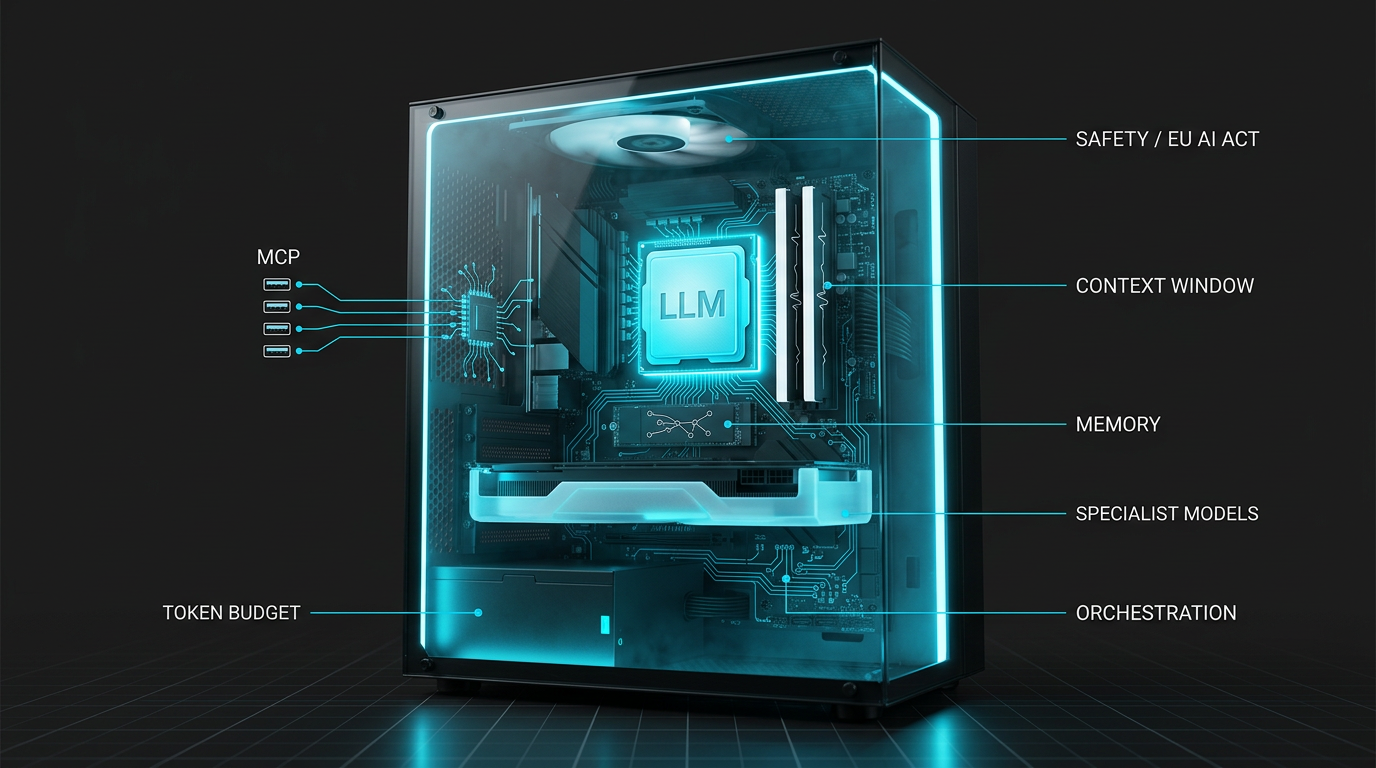
If AI Was a Computer
When you spec a new server, you do not buy a CPU and stop. You think in components: CPU, RAM, SSD, network card, power supply, motherboard. The bill of materials has fifteen lines, and every line has a reason. AI system architecture in 2027 deserves the same discipline, and almost no team treats it that way yet.
Yet when most teams build AI in 2026, they pick a model and stop. They subscribe to ChatGPT, plug Claude into a chat surface, and call the project complete. Six months in they hit a wall: the assistant forgets every previous session, cannot reach internal data, hallucinates account names, and has no audit trail when the compliance team finally asks. The team blames “AI” and starts looking at the next model. The model was never the problem. They bought a CPU and tried to run a company on it.
AI system architecture in 2027 looks much more like a PC build than a single model behind an API. Multiple parts, each picked for a reason, each replaceable on its own. I want to walk you through the full build sheet, slot by slot, with the role of every component and a concrete pick per slot for an EU mid-size company. If you would rather have me draft your own build sheet against your stack, start here.
Why “we use ChatGPT” stops working in 2027
The cost of treating AI as a single product is structural. ChatGPT in the browser is the demo board; the real system is bigger, and procurement teams are about to ask for it.
Three forces show up over the next eighteen months. The EU AI Act enforcement window for high-risk and general-purpose systems is closing through 2026 and 2027; auditors will want to know what your system is doing, what data it touched, and which model produced what answer. The Model Context Protocol moved under the Linux Foundation in 2025, and internal MCP gateways are now appearing inside enterprises faster than internal API gateways did a decade ago. And the gap between teams running a real agent stack and teams running a chat window is widening fast: the first group ships agents that act, the second group ships agents that talk.
By 2027, “we use ChatGPT” will not pass a procurement review. “Here is our build sheet” will. So let me show you what is on mine.
The AI system architecture, slot by slot
CPU: the model
The model is the processor. In a 2027 system you will run more than one, the same way a high-end workstation runs an Intel chip and an Nvidia GPU because they are good at different jobs.
My current default mix: Claude Sonnet 4.6 for coding and structured reasoning, Claude Opus 4.7 for the deep planning tasks where I want the model to actually think before it acts, and Kimi K2 via OpenRouter as the cheap workhorse for high-volume agentic loops where every token matters. For multilingual work in Croatian and English I lean on Kimi K2; for English-only legal or financial reasoning I stay on Claude. Picking the CPU mix is the part most teams already do well. It is also the part that matters least if everything else is missing.
RAM: the context window and prompt cache
The context window is your working memory. It is fast, expensive, and gone the moment the turn ends. 200K tokens is the new baseline; one-million-token windows are becoming common for the frontier models, and prompt caching is now table stakes on the inference side.
Treat the context window the way you treat RAM on a real box: do not load junk into it. Every token you put in front of the model costs you in latency, money, and quality, because models pay attention worse the further the relevant token is from the top of the window. I think of prompt caching as the L3 cache on a CPU. The first call is cold; the next twenty calls in the same session are practically free.
SSD: long-term memory
The model itself remembers nothing between sessions. Long-term memory is a separate component, the SSD of the build.
In practice this is a vector database for semantic search plus a small graph or relational store for entities and relationships. My current self-hosted stack uses MemPalace, which wraps ChromaDB for vectors and SQLite for the entity graph, and exposes both through 29 MCP tools the agent can call directly. For team-scale deployments I have also wired pgvector inside Postgres so the long-term memory lives next to the application data already under EU jurisdiction. Pinecone and Weaviate are fine engineering choices; I avoid them when the client cares about where the embeddings physically sit.
Without long-term memory your agent has amnesia. With it, the agent remembers what it learned about your business last quarter and brings it forward the next time you ask.
BIOS: the system prompt and agent skeleton
The BIOS boots the computer into character. For an AI system, the BIOS is the system prompt plus the project files the runtime loads at session start: CLAUDE.md, the agent’s role definition, the working directory map, the policy file. It is small, boring, and absolutely decisive. The wrong BIOS and the CPU runs but does not know what computer it is in.
I keep ours version-controlled in git, with one file per agent role. Every change is a commit. Every project ships with its own.
Operating system: the agent runtime
This is the layer that schedules tasks, calls tools, persists state, handles retries, and streams output back to the user. In a 2027 build sheet the agent runtime is the operating system, and picking one will feel exactly like picking Linux versus Windows ten years ago.
The shortlist I work from: Claude Code when the team lives in the terminal and the agent is a coding partner, LangGraph or the Microsoft Agent Framework when the team wants programmatic Python control over multi-step graphs, n8n when the team is non-engineering and wants a visual workflow with AI nodes, OpenClaw when the agent needs to live inside a messaging channel like WhatsApp or Slack. Pick one and commit. The runtime defines how the rest of your build plugs together, and swapping it later costs more than swapping the model behind it.
I/O bus: MCP
Model Context Protocol is the I/O bus. It is the USB of AI: a single standard for plugging tools, databases, files, browsers, and internal APIs into any model that speaks the protocol. Anthropic moved MCP under the Linux Foundation in 2025, and every major vendor now ships MCP support. By 2027, almost every mid-size company will run an internal MCP gateway, a single endpoint that exposes their tools to any agent behind one identity and access boundary.
Build your stack around MCP from day one. The model behind the bus will keep changing. The bus itself is the part you keep.
Peripherals: the tools plugged into the bus
Tools are the keyboard, mouse, monitor, and printer of the build. A code interpreter, a browser, the filesystem, your email, your calendar, your CRM, your data warehouse. Each one shows up as an MCP server in 2027. The right peripheral set depends on the job the agent is hired for. A research agent needs a browser and a vector store. A back-office agent needs your CRM, your billing system, and a writing tool. The list is short for any one agent and stays short on purpose.
GPU: specialised models
The CPU is general-purpose. The GPU is the specialist you offload to when the CPU is the wrong tool. For an AI system the GPU slot holds your vision model, your speech-to-text model, your embedding model, and any small fine-tuned model you run for a narrow task. In my stack right now: Gemini for vision when the task is image-heavy, Whisper for audio, BGE or OpenAI embeddings for text vectors, and the occasional small open model for a classification task that does not deserve a frontier-model call.
Network card: the integration layer
The network card is what connects your AI to the rest of your business. API connectors to Salesforce, Snowflake, your ERP, your data lake, your support system. Without it, the agent is a brilliant local-only machine that cannot reach the parts of the company that pay its electricity bill. In a 2027 stack I expect almost all of these connectors to be exposed as MCP servers, which collapses the network card and the I/O bus into one layer.
Power supply: the inference budget
Power is the part nobody thinks about until the lights flicker. For an AI system the power supply is the token economy: which models cost what per call, which workflows can afford which model, and what your monthly burn looks like. Teams that do not budget tokens the way they budget cloud compute will see surprise invoices that kill the project’s internal sponsor faster than any technical failure.
Cooling: the safety and audit layer
On a real PC, cooling is not optional, and you only notice it when it fails. The safety layer of an AI stack works the same way. Prompt-injection detection, content filters, audit logs, model and tool registries, a kill switch when an agent starts doing something it should not. The EU AI Act bakes this in. Procurement asks for it. Your future self, the one being interviewed by a regulator, will thank the current you who built it from day one.
Motherboard: the orchestration layer
The motherboard ties everything together. In an AI system this is your orchestration layer: the place where tasks are decomposed, agents are routed, retries happen, and state moves between turns. n8n if the orchestration is visual and triggered by business events. LangGraph or the Microsoft Agent Framework if it is programmatic. An internal MCP gateway in front of all of it. Nobody buys the motherboard first, but the motherboard decides what else fits in your case.
How to draft your own 2027 build sheet
If I were starting today, here is the order I would actually work in.
Draw your current AI stack on a single page. Be honest about what is missing. Most teams have a CPU, no RAM strategy beyond “we use the default context window,” no SSD at all, and a motherboard nobody picked on purpose. The empty slots are the cheapest things to fix and the most consequential.
Commit to one runtime. Pick the OS, write it down, and stop swapping. The cost of swapping the agent runtime is not technical; it is institutional. Your team stops shipping for two months while everyone relearns the basics.
Stand up long-term memory before you scale anything else. A €20-per-month VPS running MemPalace or a Postgres with pgvector buys you more value in the first quarter than any model upgrade you can pay for. Without memory, every conversation is the first conversation.
Standardise on MCP. Treat every internal tool you expose to an agent as an MCP server. By 2027 the alternative is rebuilding your tool layer from scratch.
Budget your power supply. Set a monthly token ceiling per workflow before the workflow goes to production. Use a cheap model for the loop and a frontier model only at the decision points that justify it.
Wire cooling in early. Audit logs, prompt-injection guardrails, a registry of what is plugged in. The EU AI Act audit your team will face in 2027 starts with one question: what is in your stack? The build sheet is the answer.
The shift
What if your AI was a computer? It already is. We just have not started speccing it that way. The companies that win the 2027 procurement cycle are the ones with a real bill of materials, not a single model behind a chat window. If your stack today is one model and a text box, you have bought a CPU and powered it on. The rest of the build sheet is waiting.
I think the next interesting question is not which model is best. It is which build you are running, and which slot you fill next quarter.
Frequently Asked Questions
What does it mean to treat an AI system like a computer?
It means thinking of your AI in components instead of as a single product. The model (CPU) does the reasoning, the context window (RAM) holds what it is working on right now, a vector and graph store (SSD) holds long-term memory, an agent runtime (operating system) orchestrates tasks, and MCP servers (I/O bus) plug in tools like files, browsers, and internal APIs. Each component is picked for a reason, the way you would spec a server. By 2027 this is the default mental model for serious teams, not an analogy.
Why is MCP important for AI architecture in 2027?
Model Context Protocol is the standard interface between an LLM and the outside world. It is the USB of AI. Anthropic moved MCP under the Linux Foundation in 2025 and almost every major vendor has shipped MCP support. By 2027, most enterprises will run an internal MCP gateway that exposes their tools, databases, and APIs to any agent behind one identity boundary. Picking MCP early means the rest of the stack stays portable across model vendors.
What is the difference between context window and AI memory?
The context window is the working memory the model can read in a single turn. It is fast, expensive, and lost the moment the session ends. Long-term memory lives outside the model, usually in a vector database for semantic search and sometimes a graph store for entities and relationships. The agent retrieves what it needs from long-term memory and loads it into the context window for the current task. The model itself does not remember anything between turns; the memory layer does.
Which agent runtime should an EU company pick in 2027?
The choice depends on the team. Teams that already write Python and want full control pick LangGraph or the Microsoft Agent Framework. Engineering teams that want a terminal-native coding assistant standardise on Claude Code. Non-engineering teams that want a visual workflow pick n8n with its AI nodes. The important call is to pick one and stop swapping. The runtime defines how the rest of your stack plugs together; switching it costs more than switching the model behind it.
How do EU companies stay AI Act compliant inside this architecture?
Treat the safety layer like cooling on a real PC: not optional. Log every tool call, every model call, and every memory write. Keep your long-term memory and audit logs in EU jurisdiction. Use a guardrails layer in front of the model for content filtering and prompt injection detection. Maintain a single registry of which models, tools, and data sources are in use, with a person responsible for each. The AI Act asks you to know what your system is doing; the build sheet is what you hand the auditor.